
GFRC vs Traditional Concrete: What's the Difference?
Glass Fibre Reinforced Concrete (GFRC) and traditional concrete may look similar, but they're designed for very different purposes. Here's how they compare.
GFRC vs Traditional Concrete at a Glance
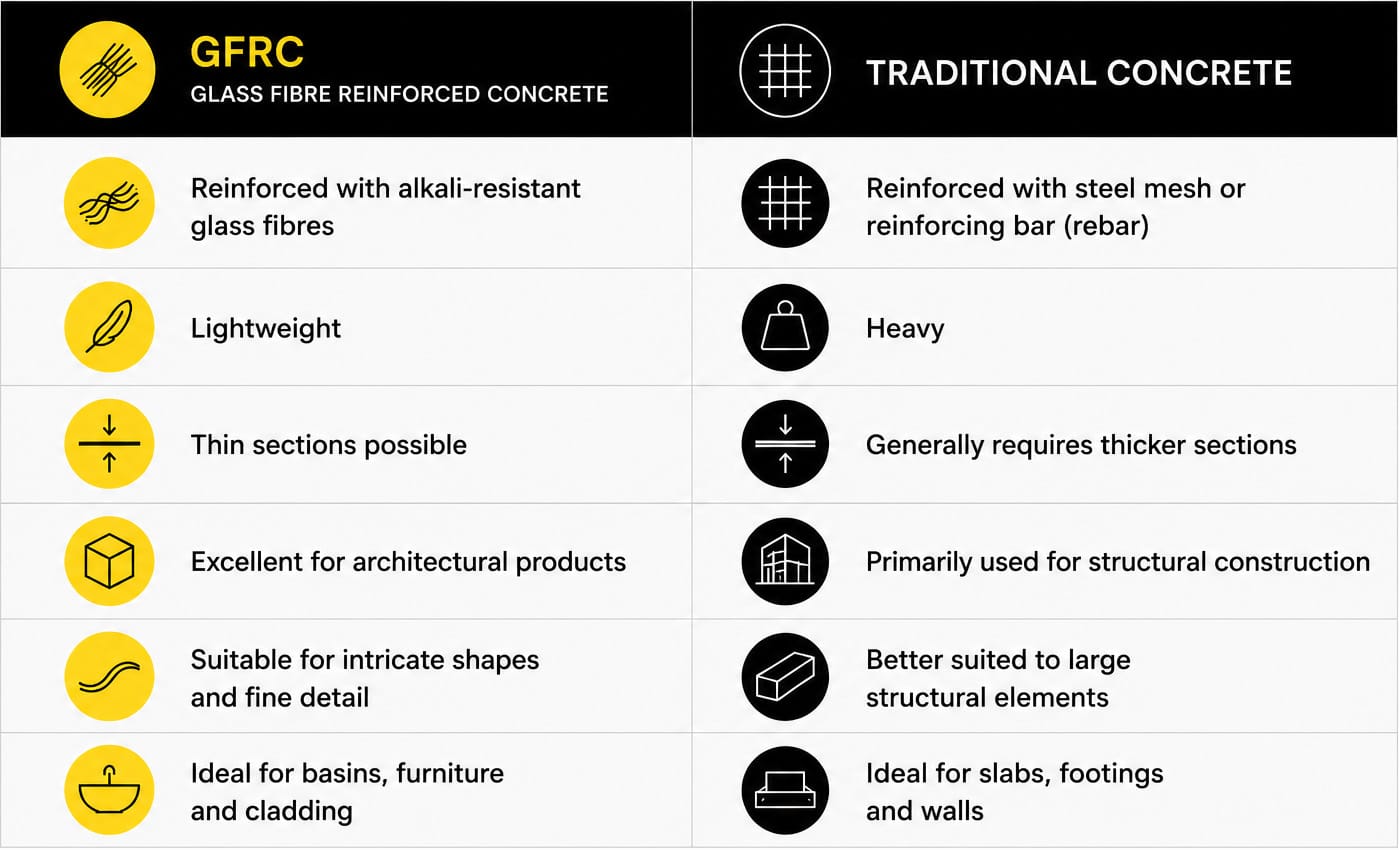
Traditional Concrete
Traditional concrete is the material used to construct buildings, bridges, roads and foundations.
It achieves its strength through its mass and is often reinforced with steel bars or mesh to resist tensile forces.
Because of this, traditional concrete usually needs to be relatively thick and heavy.
It is an excellent structural material, but it isn't always the best choice for finely detailed architectural products.
What Makes GFRC Different?
GFRC was developed specifically for architectural applications.
Instead of relying on steel reinforcement, it uses thousands of alkali-resistant glass fibres distributed throughout the concrete mix.
This reinforcement allows manufacturers to produce concrete pieces that are significantly thinner and lighter while maintaining excellent strength.
The result is a material that's easier to handle, easier to install and capable of much more refined designs.
Thickness
One of the biggest differences between the two materials is thickness.
Traditional concrete generally requires thicker sections to achieve the required strength.
GFRC can often be manufactured in much thinner sections, allowing for elegant profiles that would be difficult or impractical using conventional concrete.
This is one of the reasons modern concrete basins and vanity tops can appear so slim while remaining durable.
Weight
Because GFRC uses thinner sections, finished products are considerably lighter than equivalent pieces made from traditional concrete.
This offers several advantages:
Easier transportation
Simpler installation
Reduced load on cabinetry and supporting structures
Greater flexibility for designers
For architectural products, reducing weight without sacrificing durability is a significant advantage.
Design Flexibility
GFRC contains fine sand rather than coarse stone aggregate.
This allows it to reproduce much finer detail during casting, making it ideal for products with crisp edges, smooth curves and complex forms.
Designers can create shapes that would be difficult to achieve using conventional concrete.
Durability
Both materials are extremely durable when manufactured correctly and used for their intended purpose.
Traditional concrete is designed to carry structural loads in buildings and infrastructure.
GFRC is engineered for architectural applications where appearance, durability and reduced weight are equally important.
When properly manufactured, sealed and maintained, GFRC performs exceptionally well in bathrooms, kitchens and commercial interiors.
Which Material is Better?
Neither material is "better" than the other.
They are designed for different applications.
Choose traditional concrete when building structural elements such as foundations, walls or slabs.
Choose GFRC when creating architectural products such as:
Concrete basins
Vanity tops
Furniture
Reception desks
Wall cladding
Decorative features
For these applications, GFRC offers a combination of strength, reduced weight and design flexibility that conventional concrete simply wasn't designed to provide.
Why Concrete Studio Uses GFRC
Every product we manufacture is designed to balance performance with design. GFRC allows us to create clean, contemporary forms without the excessive weight associated with traditional concrete. It also gives us greater control over detail, consistency and finish, helping us produce architectural concrete products that are both practical and beautifully crafted.
Frequently Asked Questions
Is GFRC stronger than traditional concrete?
They are designed for different purposes. Traditional concrete is intended for structural construction, while GFRC provides excellent strength relative to its weight for architectural products.
Why doesn't GFRC use steel reinforcement?
Glass fibres reinforce the concrete throughout the mix, removing the need for steel reinforcement in many architectural applications while allowing much thinner sections.
Is GFRC more expensive?
GFRC manufacturing is more specialised than conventional concrete, but it offers significant advantages in weight, finish and design possibilities that make it well suited to premium architectural products.
Can traditional concrete be used to make basins?
It can, but the finished products are generally much heavier and bulkier than those made using GFRC.