
What is Microcement?
Microcement is a decorative cement-based coating that creates a seamless, contemporary finish over existing surfaces. Unlike traditional concrete or GFRC, it isn't a structural material but a thin decorative coating that can be applied to floors, walls, bathrooms, furniture and benchtops.
What is microcement?
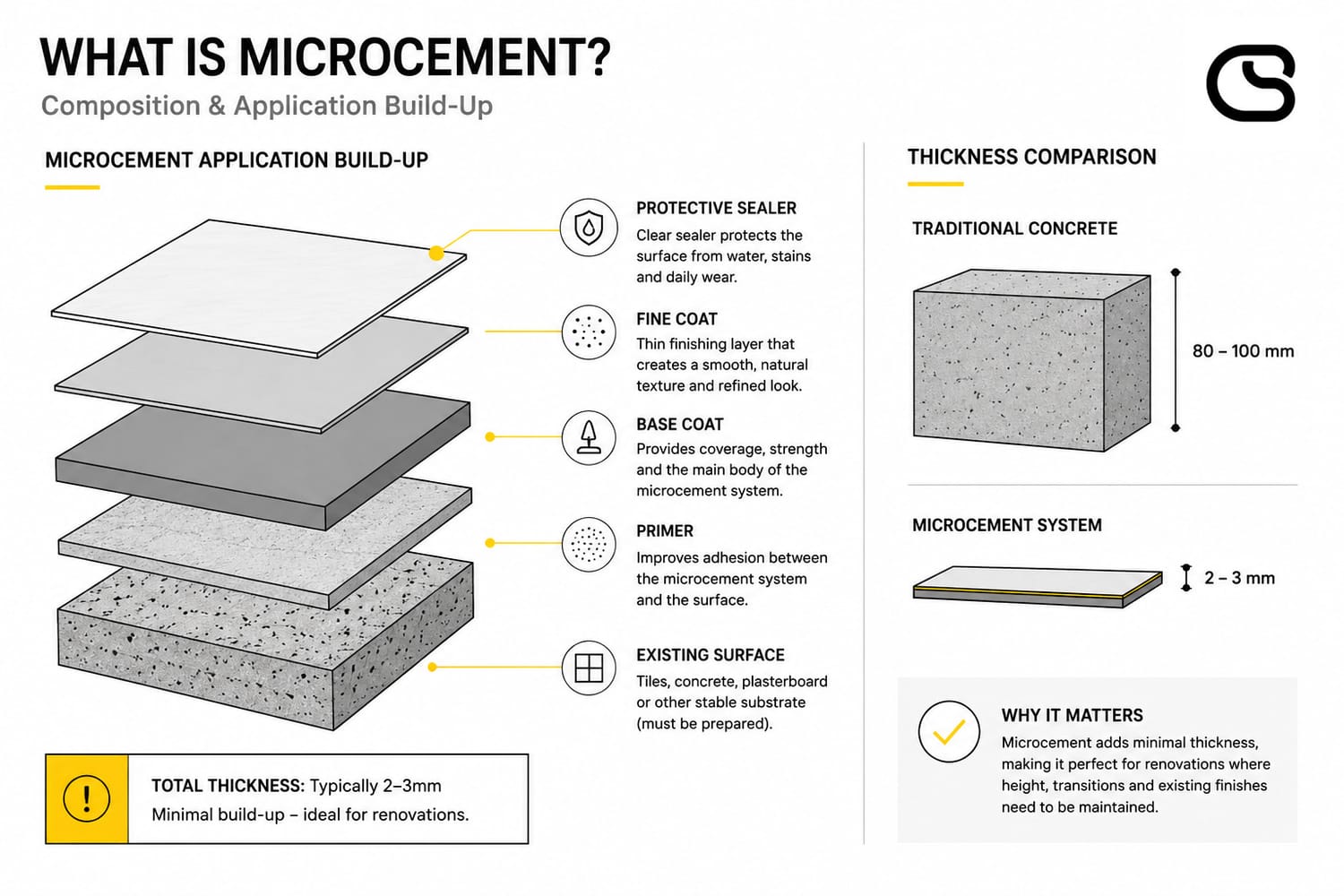
Microcement is a high-performance decorative coating made from cement, fine aggregates, polymers, resins and pigments. It is applied in thin layers, typically just 2-3 mm thick, directly over prepared surfaces.
Because it bonds to existing substrates, microcement is often used during renovations to transform spaces without removing tiles, concrete or plasterboard. Its seamless appearance and minimal thickness have made it increasingly popular in modern residential and commercial interiors.
Is microcement real concrete?
Yes, but not in the way your think! Microcement is a cement-based coating, rather than a structural concrete. It shares some characteristics with concrete, including its mineral appearance and natural variation, but it is formulated specifically to be applied in thin layers. Think of it as a decorative finish rather than a building material.
What is microcement made from?
While formulations vary between manufacturers, microcement generally contains:
Cement
Fine mineral aggregates
Polymers and resins
Pigments
Additives that improve adhesion and flexibility
After application, the surface is protected with specialist sealers to improve stain and water resistance.
Where can microcement be used?
One of microcement's biggest advantages is its versatility.
It can be applied to a wide variety of interior surfaces including:
Bathroom walls
Shower enclosures
Floors
Kitchen splashbacks
Benchtops
Feature walls
Staircases
Built-in furniture
Because it is applied in thin layers, it can often be installed over existing finishes, reducing demolition during renovations, cover up those tiles that you don't like anymore.
Why is microcement so popular?
Microcement has become popular because it creates a clean, seamless finish with very few visible joins. Its minimalist appearance works well in contemporary architecture while also providing a practical, durable surface when installed correctly. Many architects and interior designers choose microcement because it allows multiple surfaces within a room to share the same continuous finish.
Is microcement waterproof?
Microcement itself is not waterproof. Like concrete, it requires a specialist sealing system to protect it from moisture and staining. When correctly installed and sealed, it performs exceptionally well in bathrooms, kitchens and other wet areas.
How thick is microcement?
One of its defining characteristics is its thickness. Most systems are applied at approximately 2-3 mm, making it ideal for renovation projects where floor heights and existing finishes need to remain largely unchanged.
Frequently Asked Questions
Is microcement the same as concrete?
No. Microcement is a decorative cement-based coating, while traditional concrete is a structural building material.
Can microcement go over tiles?
In many cases, yes. With the correct preparation, microcement can often be applied over existing tiled surfaces.
Does microcement crack?
A correctly installed microcement system is designed to minimise cracking. As with any finish, the condition of the substrate and quality of installation are critical.
Can microcement be used in showers?
Yes. When installed and sealed correctly, microcement is widely used in showers and bathrooms.